The 2026 U.S. Counterterrorism Strategy redefines who counts as a terrorist. The implications should unsettle every American.
On May 2026, the White House released its new United States Counterterrorism Strategy. It is sixteen pages long and written in the language of strength and security. Buried inside its rhetoric of protecting Americans is a framework that could be used to treat political dissent as a national security threat.
This is not speculation. This is what the document says.
The Three Threats
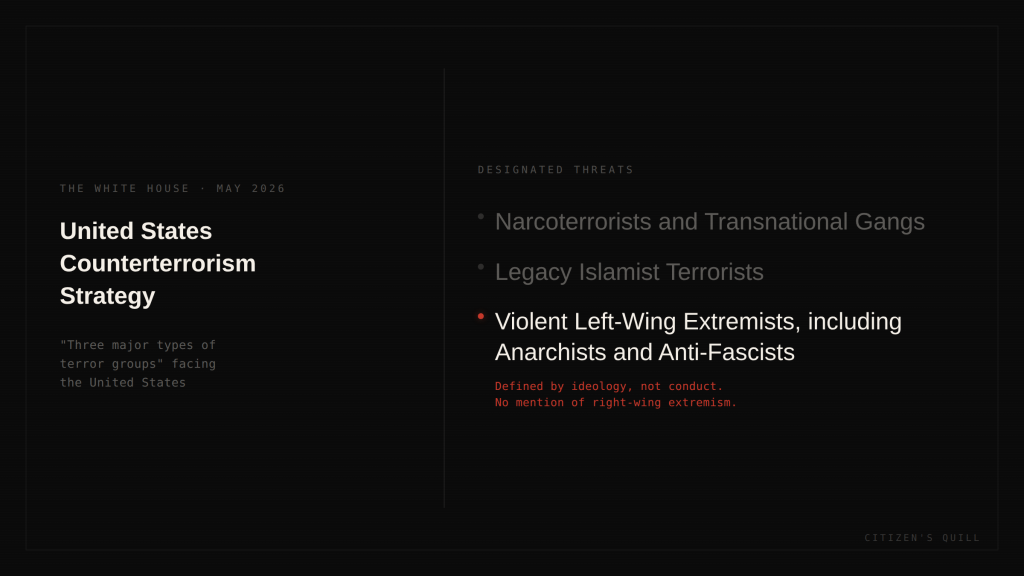
The strategy identifies three ‘major types of terror groups’ facing the United States:
- Narcoterrorists and Transnational Gangs
- Legacy Islamist Terrorists
- Violent Left-Wing Extremists, including Anarchists and Anti-Fascists
Two of those categories describe organizations with body counts, supply chains, and operational histories spanning decades. The third is a political label.
The document does not define what makes someone a ‘violent left-wing extremist.’ It does not establish thresholds of conduct, organizational membership, or criminal activity. Instead, it describes this threat category using language like ‘radical ideologies antithetical to the American way of life,’ ‘anti-American’ beliefs, and – remarkably – being ‘radically pro-transgender.’
That is not a security criterion. That is an ideological litmus test written into a counterterrorism framework.
What the Document Actually Authorizes
The strategy lays out three operational goals for counterterrorism:
- Identify terror actors and plots before they happen.
- Cut off their arms, funding, and recruiting streams.
- Ultimately destroy established threat groups.
Applied to cartels smuggling fentanyl, these are comprehensible objectives. Applied to a vaguely defined category of domestic political actors, they describe a surveillance-and-suppression apparatus aimed at Americans based on their beliefs.
The document goes further. It calls for using ‘all the tools constitutionally available’ to ‘map them at home, identify their membership, map their ties to international organizations like Antifa, and use law enforcement tools to cripple them operationally before they can maim or kill the innocent.’
Read that again: Map them at home. Identify their membership. Cripple them operationally.
This is the language of dismantling terrorist networks. It is being applied to a category defined not by criminal conduct but by political orientation.
The Pre-Crime Problem
One of the most consequential features of the strategy is its emphasis on prevention – identifying and ‘neutralizing’ threats before they act. In the context of foreign terrorist organizations with known operational capabilities, preemptive action has a legal and strategic basis. In the context of domestic political movements, it collides directly with the First Amendment.
The document pledges to ‘rapidly identify and neutralize violent secular political groups whose ideology is anti-American, radically pro-transgender, and anarchist.’ Note the structure of that sentence: these groups are defined first by ideology, not by conduct. Being anti-American…whatever that means…is the qualifying criterion. Violence is assumed to follow from the belief.
This is the architecture of pre-crime enforcement. And the people defining what beliefs qualify as dangerous are the same people in power.
The Conspicuous Absence
The strategy identifies three threat categories. Narcoterrorists. Islamist groups. Left-wing extremists.
What is not on the list? Right-wing extremism.
This is not a minor omission. The FBI’s own data over past decades – the data produced by the intelligence community this administration claims was ‘weaponized’ – has consistently identified domestic violent extremism, particularly from racially motivated and anti-government actors on the right, as among the most persistent threats to the homeland. The January 6th attack on the Capitol. The El Paso Walmart shooting. The Pittsburgh synagogue massacre. The plot to kidnap the governor of Michigan.
None of this appears in the strategy. Not one sentence. The document instead references the ‘assassination of Charlie Kirk by a radical who espoused extreme transgender ideologies’ as the definitive example of domestic political violence. A single event is elevated. An entire, well-documented pattern of right-wing violence is erased.
When a government’s threat assessment selectively ignores one end of the political spectrum while designating the other as a terrorist category, that is not a security strategy. That is a political instrument.
‘We Will Find You and We Will Kill You’
The Presidential Foreword ends with this sentence, attributed directly to President Trump. It appears above his signature.
In the context of hunting foreign terrorist operatives, this is aggressive but within the norms of wartime rhetoric. In a document that has just classified domestic political movements as terrorist threats, it reads very differently.
Who is ‘you’? The document has just told us: narcoterrorists, Islamists, and left-wing extremists. When you collapse the distinction between a cartel kingpin and a person with ‘anti-American’ political views, the threat inherent in that sentence expands to cover everyone the government decides to label.
The Intelligence Community as Political Tool – and the Irony
The strategy devotes considerable space to arguing that prior administrations ‘weaponized’ the Intelligence Community for political purposes. It pledges that counterterrorism operations will be ‘executed apolitically and founded upon reality-based threat assessments.’
And then, in the same document, it defines an entire threat category by political ideology. It calls for mapping the membership of domestic political groups. It names ‘radically pro-transgender’ as a security concern.
The document’s own logic collapses in on itself. It warns against the politicization of counterterrorism in one paragraph and conducts it in the next.
FTO Designations and Why They Matter
The strategy repeatedly references Foreign Terrorist Organization (FTO) designations, a legal tool with enormous consequences. FTO designation triggers material support statutes, asset freezes, immigration bars, and expanded surveillance authorities. The document celebrates the designation of cartels as FTOs and the Muslim Brotherhood chapters as FTOs and calls for these designations to continue expanding.
The document also refers to Antifa as an ‘international organization’ to which domestic groups have ‘ties.’ This framing, treating a decentralized, largely leaderless protest tendency as a structured international organization, is the precondition for applying FTO-adjacent tools to domestic activism. If you can characterize a domestic group as having ‘ties to international organizations,’ you can potentially invoke authorities designed for foreign threats against American citizens.
This is not hypothetical. This is how legal architecture works. You build the framework first, then you apply it.
The Midterm Question
The strategy is released in May 2026 – five months before the midterm elections. ICE is quietly and rapidly expanding its operational footprint across the country. The document classifies opposition political ideologies as terrorist threats. It authorizes preemptive action against vaguely defined domestic groups.
Whether or not this strategy is intended to suppress political participation, it creates the tools to do so. A protest movement can be characterized as a terrorist organization. An activist network can be ‘mapped’ and ‘crippled operationally.’ A political rally can be surveilled as a potential threat gathering.
The chilling effect doesn’t require a single arrest. It only requires people to believe the government might be watching and that their beliefs alone could make them a target.
The Ratchet
Here is what everyone, regardless of political affiliation, should understand about this document: government power ratchets. It expands and rarely contracts. The authorities you cheer when they’re pointed at people you dislike don’t disappear when the administration changes. They get inherited.
Today the target is ‘radically pro-transgender’ ideology and ‘anti-fascist’ organizing. Tomorrow it could be ‘anti-government’ sentiment. Religious conviction. Gun rights activism. Homeschooling communities. Anyone whose beliefs become inconvenient to whoever holds power next.
The question is not whether you agree with the people currently being labeled. The question is whether you want the government to have the power to label anyone’s political beliefs as a terrorist threat…and then act on that label with the full weight of the national security apparatus.
Because that is what this document authorizes.
The full text of the 2026 United States Counterterrorism Strategy is publicly available from the White House. Every claim in this post is drawn directly from the document. Read it yourself.
 Citizen's Quill
Leave a comment