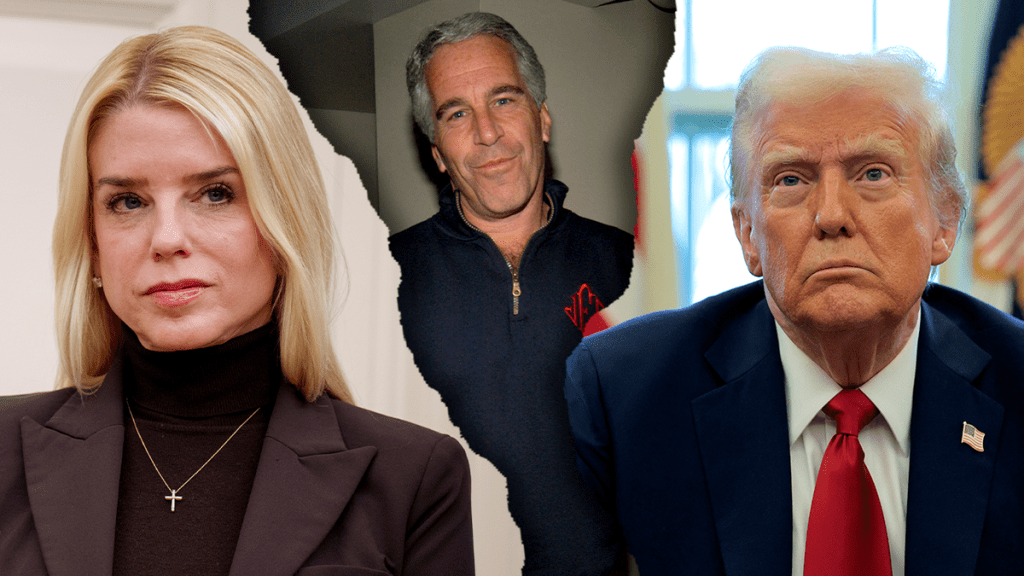
Pam Bondi’s appearance today before the House Judiciary Committee on the Epstein files was a disgraceful display of deflection, partisan attack, and disregard for survivors rather than a good‑faith effort to answer to the public.
Weaponizing the Hearing
Instead of engaging substantively with Democratic questions about why Epstein associates were shielded while victims were exposed, Bondi repeatedly dodged direct yes‑or‑no answers and pivoted to political talking points. Lawmakers from both parties described the hearing as descending into shouting matches and chaos as she lashed out at judges and members of Congress rather than addressing the core issue: whether the Department of Justice is protecting powerful men tied to Epstein.
Multiple reports note that Democrats framed the session as an indictment of her leadership, with Rep. Jamie Raskin accusing her of a cover‑up and a betrayal of the principle of justice for all, pointing to extensive redactions and the lack of clarity on who among Epstein’s network had actually been questioned. Survivors and their lawyers had already raised alarms that DOJ procedures and redactions looked more like a shield for elites than a search for accountability, a concern that Bondi did little to dispel under questioning.
Redactions Shielding Powerful Men
The central scandal is simple and damning: DOJ redacted the names of many Epstein associates while allowing personal information, email addresses, and even explicit images that could identify victims to slip through. Survivors’ attorneys publicly accused the department of failing to protect victim identities and asked a court to halt the document repository until the redaction failures were fixed.
Members of Congress who were allowed to see unredacted materials in a secured room said they found numerous completely unnecessary redactions and described DOJ as being in cover‑up mode while victims’ personal details remained visible. Even Rep. Thomas Massie, a Republican who co‑authored the law requiring release of the files, told Bondi that failing to protect victims’ identities while hiding other names was ‘literally the worst thing you could do to the survivors.’
Pressed in the hearing about these choices, Bondi defended the department’s work as its ‘very best’ (apparently the bar is rock bottom) under tight timelines and claimed the error rate was ‘very low,’ insisting that any mistakes would be corrected after the fact. That bureaucratic shrug did nothing to change the reality that survivors’ privacy had already been violated in service of a process that seemed far more careful about shielding well‑connected men than protecting the people Epstein abused.
Bondi’s Contempt for Survivors
The moral center of the hearing should have been the survivors watching from the gallery. directly behind Bondi, many of whom had publicly begged DOJ to stop retraumatizing them and start listening. Instead, coverage describes Bondi declining to express any real remorse for the fact that victims’ identities and explicit photographs appeared in government‑released files, even as those survivors sat just a few feet away.
Rep. Pramila Jayapal highlighted that many survivors had been unable to secure a substantive meeting with DOJ and directly urged Bondi to apologize for the department’s handling of redactions and victim privacy. Bondi pushed back by dismissing Jayapal’s questioning as theatrics, casting basic demands for accountability as partisan performance rather than acknowledging the real harm done.
While Bondi did offer a carefully worded expression of being deeply sorry for what any victim has been through, she used that statement mainly to bolster her own image as a lifelong prosecutor “fighting for victims” (truly unbelievable) and immediately retreated to defending the process. In practice, Bondi’s refusal to own the consequences of DOJ’s choices, and her refusal to make survivors’ dignity the non‑negotiable priority, spoke louder than any scripted sympathy.
Smearing a Holocaust Victim’s Granddaughter
One of the most shocking moments came when Bondi turned her fire on Rep. Becca Balint of Vermont, a Jewish, openly lesbian lawmaker who has spoken often about her grandfather’s murder in the Holocaust. In the course of attacking Balint’s votes, Bondi accused her of fueling an ‘anti‑Semitic culture,’ pointing to a resolution Balint opposed and using that to question her moral standing.
Balint cut her off and walked out, telling Bondi, ‘Talking about antisemitism to a woman who lost her grandfather in the Holocaust?’ Bondi attempted to smear someone whose family literally suffered under Nazi antisemitism. That exchange crystallized the broader pattern of the hearing: instead of answering hard questions about why powerful people around Epstein seem insulated, Bondi went on the attack, even if it meant weaponizing accusations of antisemitism against a Holocaust victim’s descendant.
Protecting the Powerful, Absence of Justice
Throughout the day, Democrats argued that the DOJ under Bondi has created a two‑tiered system of justice, in which survivors wait for answers while well‑connected officials and businessmen implicated in Epstein’s orbit face little visible scrutiny. Rep. Balint, for example, pressed Bondi on whether senior Trump administration figures such as Commerce Secretary Howard Lutnick, Navy Secretary John Phelan, or Deputy Defense Secretary Steven Feinberg had been seriously questioned about contacts with Epstein; Bondi refused to give clear yes‑or‑no answers and brushed off concerns.
This stonewalling sits atop a much larger pattern: DOJ identified more than 6 million potentially relevant pages and released over 3 million pages plus videos and images, yet has tightly constrained how members of Congress can review unredacted materials and has repeatedly been caught over‑redacting names that should be public while under‑protecting survivors. Lawmakers who drafted the Epstein Files Transparency Act now say outright that DOJ is protecting the powerful and letting the vulnerable languish. The fury in that hearing room reflected a growing sense that the DOJ under Bondi is more interested in playing to an audience of one – Trump – than exposing every member of the Epstein network.
There are literally mountains of evidence of child trafficking, rape, and murder. Epstein’s victims DESERVE accountability.
Impeach Pam Bondi.
BBC News. (2026, February 11). Four takeaways from Pam Bondi’s fiery Epstein testimony. BBC. https://www.bbc.com/news/articles/cq6ql2n917zo
BBC News. (2026, February 10). US lawmakers accuse justice department of “inappropriately” redacting Epstein files. BBC. https://www.bbc.com/news/articles/cn5gzepnw4lo
CBS News. (2026, February 10). Bondi faces heated questions on handling of Epstein files at House hearing. CBS News. https://www.cbsnews.com/live-updates/pam-bondi-hearing-epstein-files-justice-department-congress/
CNBC. (2026, February 11). Epstein files: Pam Bondi had Jayapal’s DOJ database search history …. CNBC. https://www.cnbc.com/2026/02/11/epstein-files-pam-bondi-jayapal-search-history-doj.html
The Advocate. (2026, February 10). Pam Bondi suggests Becca Balint of VT is anti-Semitic. The Advocate. https://www.advocate.com/politics/pam-bondi-disrespect-becca-balint
Jewish Telegraphic Agency. (2026, February 11). Rep. Becca Balint storms out of Epstein hearing after Pam Bondi raises her record on Israel. JTA. https://www.jta.org/2026/02/11/united-states/rep-becca-balint-storms-out-of-epstein-hearing-after-pam-bondi-raises-her-record-on
NBC News. (2026, February 11). Pam Bondi hearing devolves into shouting matches with Democrats over Epstein files. NBC News. https://www.nbcnews.com/politics/justice-department/pam-bondi-hearing-jeffrey-epstein-trump-rcna258522
NPR. (2026, February 11). Pam Bondi clashes with House Democrats over Epstein files at DOJ oversight hearing. NPR. https://www.npr.org/2026/02/11/nx-s1-5707280/pam-bondi-oversight-hearing-department-of-justice
PBS NewsHour. (2026, February 11). Epstein files took center stage at Bondi’s oversight hearing: Here are 3 big moments. PBS. https://www.pbs.org/newshour/politics/epstein-files-took-center-stage-at-bondis-oversight-hearing-here-are-3-big-moments
PBS NewsHour. (2026, February 11). WATCH: Pam Bondi appears at House Judiciary Committee hearing on Justice Department oversight. PBS. https://www.pbs.org/newshour/politics/watch-live-pam-bondi-appears-at-house-judiciary-committee-hearing-on-justice-department-oversight
Politico. (2026, February 11). Dems challenge Pam Bondi to address Epstein’s victims at House hearing. Politico. https://www.politico.com/live-updates/2026/02/11/congress/dems-challenge-bondi-on-epstein-00775809
Newsweek. (2026, February 10). Epstein survivors ask Pam Bondi 15 questions ahead of House testimony. Newsweek. https://www.newsweek.com/epstein-survivors-ask-pam-bondi-15-questions-ahead-of-house-testimony-11499223
ABC News (Australia). (2026, February 11). Epstein files hearing descends into shouting matches. ABC News. https://www.abc.net.au/news/2026-02-12/pam-bondi-faces-congress-questions-over-epstein-files/106329688
 Citizen's Quill
Leave a comment